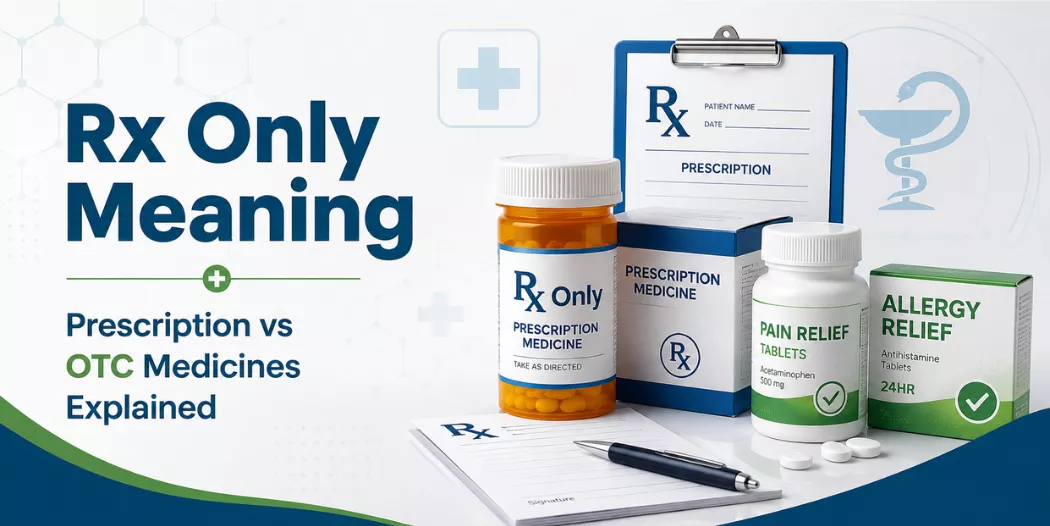
If you’ve ever looked at a medicine package or prescription label and noticed the words “Rx Only,” you may have wondered what they mean. Understanding this simple phrase is an important part of using medicines safely.
Many medications can be purchased directly from a pharmacy shelf, while others require approval from a healthcare professional before they can be dispensed. Knowing the difference helps you use medicines correctly and avoid unnecessary health risks.
This guide explains:
- What Rx stands for
- What Rx Only means
- Why some medicines require a prescription
- How prescription medicines differ from OTC medicines
- How to identify an Rx medicine
- Common prescription label terms every patient should know
Whether you’re receiving your first prescription, caring for a family member, or simply want to understand medicine labels better, this guide is designed to make the topic easy to understand.
What Does “Rx” Stand For?
The abbreviation Rx is widely recognized as a symbol for a medical prescription.
The exact origin of Rx is debated, but it is commonly believed to come from the Latin word recipe, meaning “take” or “take these ingredients.” Historically, physicians wrote this symbol at the beginning of handwritten prescriptions to instruct pharmacists to prepare and dispense medication.
Today, Rx has become a universal symbol indicating that a medicine is available only by prescription.
Simply put:
Rx = Prescription medicine
If you see Rx on a medicine package or label, it generally means that the medicine requires authorization from a licensed healthcare provider before it can be dispensed.
What Is a Prescription?
A prescription is a written or electronic order from a licensed healthcare professional that authorizes a pharmacist to dispense a specific medicine to a patient.
Depending on local laws, prescriptions may be issued by:
- Physicians (medical doctors)
- Nurse practitioners
- Physician assistants
- Dentists
- Other authorized healthcare professionals
A prescription usually includes:
| Information | Purpose |
| Patient’s name | Identifies who should receive the medicine |
| Medicine name | Specifies the prescribed drug |
| Strength | Indicates the dose (for example, 500 mg) |
| Dosage instructions | Explains how and when to take the medicine |
| Quantity | States how much medicine to dispense |
| Refills | Indicates whether additional supplies are allowed |
| Prescriber’s information | Verifies the prescription’s authenticity |
What Does “Rx Only” Mean?
Rx Only means a medicine cannot legally be sold or dispensed without a valid prescription from an authorized healthcare provider.
This designation helps protect patients by ensuring that medicines requiring professional evaluation and supervision are used appropriately.
Medicines labeled Rx Only are intended to be used only after a healthcare professional has:
- Evaluated your symptoms
- Diagnosed your condition
- Determined that the medicine is appropriate
- Considered possible risks and benefits
- Reviewed other medicines you take
- Checked for allergies or medical conditions that could affect treatment
What Does “Rx Only” Mean on a Medicine Label?
When you see “Rx Only” on a medicine package, it indicates that:
- The medicine requires a prescription.
- It should be dispensed by a licensed pharmacy.
- It should be taken only as directed by your healthcare provider.
- Additional monitoring or follow-up may be necessary.
Does “Rx Only” Mean the Medicine Is Dangerous?
Not necessarily.
Many prescription medicines are safe and highly effective when used correctly. However, they require professional oversight because they may:
- Have stronger effects on the body
- Require the correct diagnosis
- Need dose adjustments
- Interact with other medicines
- Cause significant side effects in some people
- Require monitoring through follow-up visits or laboratory tests
The Rx Only label is primarily a safety measure, not a warning that the medicine is inherently dangerous.
Why Is “Rx Only” Important?
The designation helps prevent:
- Incorrect self-diagnosis
- Inappropriate medicine use
- Serious drug interactions
- Incorrect dosing
- Antibiotic misuse
- Unnecessary side effects
- Medication misuse
By requiring a prescription, healthcare providers can help ensure that patients receive the most appropriate treatment for their condition.
Why Are Some Medicines Prescription Only?
Not all medicines have the same level of risk. Some are considered safe for most people to use without medical supervision, while others require careful evaluation before use.
A medicine may be classified as Rx Only for several reasons.
1. It Requires a Professional Diagnosis
Many medical conditions share similar symptoms.
For example, a persistent cough could result from:
- A viral infection
- Pneumonia
- Asthma
- Acid reflux
- Heart failure
- Allergies
Choosing the wrong medicine without identifying the underlying cause may delay appropriate treatment or worsen the condition.
2. It May Cause Serious Side Effects
Some prescription medicines have side effects that require monitoring by a healthcare professional.
Examples include:
- Changes in blood pressure
- Liver problems
- Kidney effects
- Bleeding risk
- Allergic reactions
- Changes in blood sugar
- Heart rhythm changes
Healthcare providers weigh these risks against the expected benefits before prescribing treatment.
3. It Can Interact with Other Medicines
Prescription medicines may interact with:
- Other prescription drugs
- Over-the-counter medicines
- Vitamins
- Herbal supplements
- Certain foods
- Alcohol
These interactions can reduce effectiveness or increase the risk of side effects.
4. Correct Dosage Matters
Many prescription medicines must be tailored to the individual.
Factors that influence dosing include:
- Age
- Body weight
- Kidney function
- Liver function
- Pregnancy status
- Other health conditions
Using the wrong dose may make the medicine less effective or increase the risk of adverse effects.
5. Some Medicines Need Regular Monitoring
Certain treatments require ongoing follow-up to ensure they remain safe and effective.
Monitoring may involve:
- Blood tests
- Blood pressure checks
- Blood sugar monitoring
- Kidney function tests
- Liver function tests
- Regular follow-up appointments
These evaluations help healthcare providers adjust treatment when necessary.
6. They Have a Higher Risk of Misuse
Some prescription medicines have the potential for misuse or dependence if not used as directed.
Examples include certain:
- Pain medicines
- Sleep medications
- Anxiety medications
- Stimulants
Additional prescribing and dispensing regulations help reduce these risks.
Prescription (Rx) vs Over-the-Counter (OTC) Medicines
One of the easiest ways to understand “Rx Only” is to compare prescription medicines with over-the-counter (OTC) medicines.
Although both types are used to treat or prevent health conditions, they differ in how they are obtained, who supervises their use, and the level of medical guidance required.
Rx vs OTC Comparison Table
| Feature | Prescription (Rx) Medicines | Over-the-Counter (OTC) Medicines |
| Prescription required? | ✅ Yes | ❌ No |
| Who approves use? | Licensed healthcare provider | Patient follows package instructions |
| Purchased from | Licensed pharmacy | Pharmacies, supermarkets, convenience stores, online retailers (where permitted) |
| Medical supervision | Usually required | Usually not required |
| Risk level | May require monitoring due to potential side effects or interactions | Generally considered safe when used exactly as directed |
| Dosage | Individualized based on the patient’s condition | Standard dosing provided on the Drug Facts label |
| Follow-up | May require appointments or laboratory tests | Usually not necessary |
| Examples | Antibiotics, blood pressure medicines, insulin, antidepressants | Acetaminophen, ibuprofen, antacids, allergy medicines |
Quick Tip: Some medicines are available in both prescription and OTC strengths. For example, certain allergy medicines or acid reflux medicines may have prescription-strength and non-prescription versions depending on the dose or intended use.
Examples of Prescription (Rx) Medicines
Prescription medicines are used to treat many different medical conditions. A healthcare provider determines whether they are appropriate based on your symptoms, medical history, and other factors.
Some common categories include:
| Medicine Category | Common Purpose |
| Antibiotics | Treat bacterial infections |
| Blood pressure medicines | Help manage high blood pressure |
| Diabetes medicines | Help control blood sugar |
| Asthma inhalers | Improve breathing and reduce airway inflammation |
| Antidepressants | Treat depression and certain anxiety disorders |
| Cholesterol-lowering medicines | Reduce cholesterol levels |
| Thyroid medicines | Treat thyroid disorders |
| Prescription pain medicines | Manage moderate to severe pain |
Examples
Examples of medicines that are typically available only with a prescription include:
- Amoxicillin
- Metformin
- Lisinopril
- Levothyroxine
- Insulin products
- Sildenafil (in many countries and situations)
- Atorvastatin
Availability varies by country. Some medicines that require a prescription in one country may be available under different regulations elsewhere.
Examples of Over-the-Counter (OTC) Medicines
OTC medicines are intended for common health conditions that people can usually recognize and manage without a prescription.
Examples include:
| OTC Medicine Type | Common Use |
| Pain relievers | Headache, fever, minor pain |
| Antacids | Heartburn and acid indigestion |
| Allergy medicines | Seasonal allergy symptoms |
| Cough medicines | Temporary cough relief |
| Cold medicines | Relief of common cold symptoms |
| Hydrocortisone cream | Minor skin irritation and itching |
| Oral rehydration products | Prevent or treat dehydration |
Common OTC medicines include:
- Acetaminophen
- Ibuprofen
- Calcium carbonate antacids
- Cetirizine
- Loratadine
- Saline nasal spray
Even though these medicines are available without a prescription, they should still be used according to the package instructions.
Can an OTC Medicine Become Prescription-Only?
Yes.
Health authorities may change a medicine’s status if new safety information becomes available.
Similarly, some medicines that were once available only by prescription may later become OTC after studies show they can be used safely without direct medical supervision.
This process helps ensure medicines remain available in the safest way possible.
How to Identify an Rx Medicine
If you’re unsure whether a medicine requires a prescription, look for these clues.
Step 1: Check the Medicine Label
Many prescription medicines display wording such as:
- Rx Only
- Prescription Only
- Rx
This is often printed on the outer carton, bottle, blister pack, or prescribing information.
Step 2: Look for Prescription Information
Prescription medicines commonly include:
- Prescription number
- Prescriber’s name
- Pharmacy name
- Patient’s name
- Directions for use
- Refill information
- Dispensing date
These details are usually found on the pharmacy label attached after dispensing.
Step 3: Check the Package Insert
Prescription medicines often include a Package Insert or Prescribing Information intended for healthcare professionals. Many also include a Medication Guide or Patient Information Leaflet with instructions for patients.
These documents may explain:
- Approved uses
- Dosage instructions
- Warnings
- Side effects
- Drug interactions
- Storage recommendations
Step 4: Ask Your Pharmacist
If you’re uncertain whether a medicine requires a prescription or how to use it, your pharmacist is an excellent source of information.
They can explain:
- Whether the medicine is prescription-only
- How to take it correctly
- Possible side effects
- Drug interactions
- Storage instructions
- What to do if you miss a dose
Step 5: Verify Through Trusted Sources
When checking medicine information online, use reliable health resources rather than relying on social media or unverified websites.
Trusted sources include:
- Government health agencies
- National medicine databases
- Hospital websites
- Reputable healthcare organizations
Signs a Medicine Is Likely Prescription-Only
It says Rx Only on the package.
- A pharmacy asks for a valid prescription before dispensing it.
- The label includes your name and the prescriber’s name.
- It has individualized dosing instructions.
- Regular medical monitoring is recommended.
Common Prescription Label Terms
Prescription labels contain important information to help you use your medicine safely.
Understanding these terms can reduce medication errors.
| Label Term | Meaning |
| Rx Only | Dispensed only with a valid prescription |
| Sig | Directions for taking the medicine |
| Refills | Number of additional supplies allowed |
| Dispense | Quantity provided by the pharmacy |
| Generic Name | Official name of the medicine’s active ingredient |
| Brand Name | Manufacturer’s brand name for the medicine |
| Strength | Amount of active ingredient (for example, 250 mg or 20 mg) |
| Dosage | How much medicine to take |
| Route | How the medicine should be taken (by mouth, injection, topical, etc.) |
| Expiration Date | Last date the medicine should be used, according to labeling |
| Beyond-Use Date (BUD) | Date after which a compounded or certain dispensed medicine should not be used |
Common Pharmacy Abbreviations
Healthcare professionals may use abbreviations on prescriptions, although many pharmacies now prefer plain language to improve safety.
| Abbreviation | Meaning |
| PO | By mouth |
| BID | Twice daily |
| TID | Three times daily |
| QID | Four times daily |
| PRN | As needed |
| HS | At bedtime |
| AC | Before meals |
| PC | After meals |
Safety Note: If any instruction on your prescription label is unclear, ask your pharmacist for clarification before taking the medicine. Never guess what an abbreviation means.
Why Reading the Prescription Label Matters
Before taking any prescription medicine, always check:
- The patient’s name
- The medicine name
- The strength
- The dosage instructions
- How often to take it
- The expiration or beyond-use date, when applicable
- Any warning labels (for example, “May cause drowsiness” or “Take with food”)
Taking a few moments to read the label each time can help prevent medication errors and support safe, effective treatment.
Medication Safety Guidance
Whether a medicine is Rx Only or over-the-counter (OTC), using it correctly is essential for your safety. Prescription medicines should always be taken exactly as directed by your healthcare provider.
Follow These Medication Safety Tips
- Take medicines exactly as prescribed.
- Read the prescription label every time before taking your medicine.
- Follow the recommended dose and schedule.
- Tell your healthcare provider about all medicines, vitamins, and herbal supplements you take.
- Store medicines according to the label instructions.
- Keep medicines out of the reach of children and pets.
- Do not use expired medicines unless advised by a healthcare professional.
- Ask your pharmacist if you have questions about your medicine.
Avoid These Common Mistakes
Never share prescription medicines
A medicine prescribed for one person may not be safe or appropriate for someone else, even if they have similar symptoms.
Don’t stop treatment without medical advice
Stopping certain medicines suddenly can reduce their effectiveness or cause unwanted effects. Speak with your healthcare provider before making changes to your treatment.
Don’t save antibiotics for later
Take antibiotics exactly as prescribed and complete the full course unless your healthcare provider advises otherwise. Saving or sharing antibiotics can contribute to antibiotic resistance and may not effectively treat future illnesses.
Don’t mix medicines without checking
Some medicines can interact with:
- Other prescription medicines
- OTC medicines
- Vitamins
- Herbal supplements
- Alcohol
- Certain foods
If you’re unsure, ask your pharmacist or healthcare provider before combining medicines.
When Should You Contact a Healthcare Professional?
Seek medical advice if you:
- Experience unexpected or severe side effects
- Think you’re having an allergic reaction
- Accidentally take the wrong dose
- Miss several doses of your medicine
- Become pregnant while taking a prescription medicine
- Have questions about how or when to take your medicine
- Are unsure whether a medicine is right for you
If you experience signs of a severe allergic reaction—such as difficulty breathing, swelling of the face or throat, or loss of consciousness—seek emergency medical care immediately.
Key Takeaways
- “Rx Only” means a medicine can only be dispensed with a valid prescription from an authorized healthcare provider.
- The Rx symbol is commonly associated with medical prescriptions.
- Prescription medicines require professional oversight because they may involve higher risks, need individualized dosing, or require monitoring.
- OTC medicines can usually be purchased without a prescription when used according to their labeling.
- Always read your prescription label carefully and ask your pharmacist if anything is unclear.
- Never share prescription medicines or use them differently from the prescribed instructions.
Conclusion
Understanding the Rx Only meaning is an important step toward using medicines safely and confidently. The label indicates that a medicine should only be dispensed with a valid prescription because it requires professional evaluation, individualized treatment, or ongoing monitoring.
Knowing the difference between prescription (Rx) and over-the-counter (OTC) medicines can help you make informed decisions about your healthcare. If you ever have questions about a prescription label or how to take your medicine, your pharmacist or healthcare provider is the best source of guidance.
As you continue learning about medication safety, explore our related EasyRxDose guides on prescription labels, common pharmacy abbreviations, prescription vs. OTC medicines, and safe medication use.
If you’d like to learn more, explore these EasyRxDose guides:
- What Is the Blue Pill?
- PDE5 Inhibitors Explained: Benefits, Uses & Safety
- What Is the Safest ED Medication?
- Treatment for Erectile Dysfunction: A Comprehensive 2026 Guide
- Why Patients Choose Telemedicine for Erectile Dysfunction
- At What Age Does Erectile Dysfunction Start?
- What Is Psychological Erectile Dysfunction?
Suggested References
Use authoritative sources to support factual and regulatory information:
- U.S. Food and Drug Administration (FDA) – Information on prescription and over-the-counter medicines.
- MedlinePlus – Trusted patient education from the U.S. National Library of Medicine.
- National Institutes of Health (NIH) – Health and medical information.
- DailyMed – Official FDA label information for prescription medicines.
- National Library of Medicine (NLM) – Drug information and medical terminology.
Frequently Asked Questions
"Rx Only" means a medicine requires a valid prescription from a licensed healthcare provider before it can legally be dispensed by a pharmacy.
Rx is the traditional symbol for a medical prescription. It is widely believed to originate from the Latin word recipe, meaning "take."
Yes. Both terms indicate that a medicine can only be supplied with a valid prescription from an authorized healthcare professional.
In many countries, including the United States, prescription medicines generally cannot be legally dispensed without a valid prescription. Regulations vary by country, so always follow local laws and pharmacy requirements.
Prescription medicines may require medical supervision because they: Have a higher risk of side effects Require a proper diagnosis May interact with other medicines Need individualized dosing Sometimes require monitoring during treatment