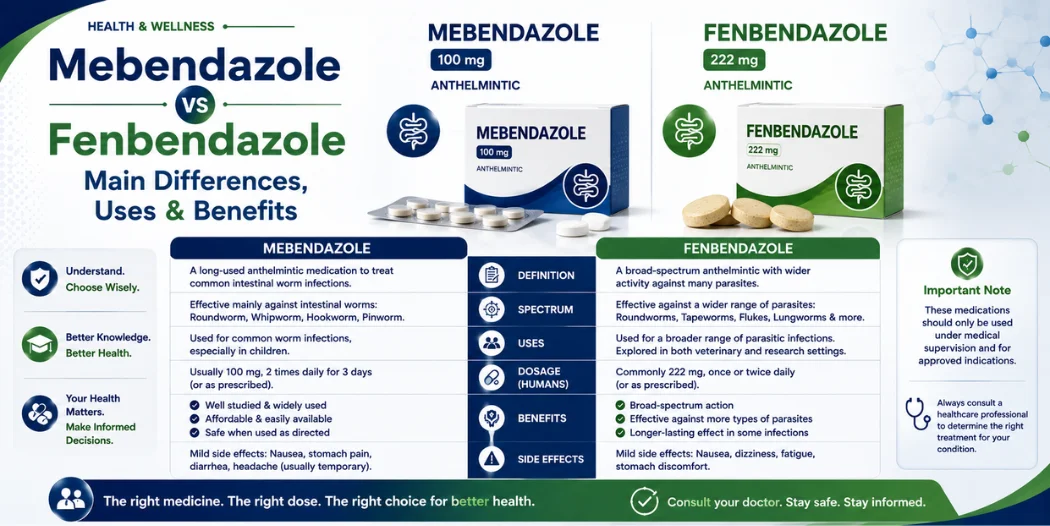
Mebendazole and fenbendazole are both medicines from the benzimidazole group of antiparasitic drugs, but they are used for different purposes. Mebendazole is used in humans to treat several intestinal worm infections, such as pinworms, roundworms, whipworms, and hookworms. Fenbendazole is mainly a veterinary deworming medicine used to treat certain parasitic infections in animals.
Both medicines have also been studied for possible uses beyond treating parasites. Mebendazole has been researched as a potential treatment in cancer studies, while fenbendazole has mainly been studied in laboratory and preclinical research. However, these studies do not mean that either medicine is an approved or proven cancer treatment.
Understanding the Mebendazole vs Fenbendazole differences can help you learn how these medicines differ in their uses, benefits, dosage, side effects, and safety. Although they belong to the same drug group, they should not be considered interchangeable.
What Is Mebendazole?
Mebendazole is a medicine used to treat certain worm infections in humans. It belongs to a group of medicines called benzimidazole anthelmintics. It can help treat common intestinal worm infections, including pinworms, roundworms, whipworms, and hookworms.
According to the U.S. prescribing information for Emverm, mebendazole is approved for adults and children aged 2 years and older for certain gastrointestinal worm infections. The medicine is available as a 100 mg chewable tablet.
Mebendazole works by affecting important processes that worms need to survive and grow. This helps stop the parasites from getting the nutrients they need and eventually leads to their removal from the body. The dose and treatment duration depend on the type of worm infection and the specific product being used.
What Is Fenbendazole?
Fenbendazole is a benzimidazole antiparasitic medicine mainly used in veterinary medicine. It helps treat and control certain worm infections in animals. The FDA has approved fenbendazole products for use in animals such as cattle and goats.
In January 2026, the FDA approved a generic fenbendazole oral suspension for certain lungworms, stomach worms, and intestinal worms in cattle and some stomach worms in goats.
Fenbendazole has also gained attention because researchers are studying its possible effects on cancer cells. Some laboratory and animal studies have explored how it may affect processes such as glucose use, oxidative stress, and apoptosis. However, fenbendazole is not approved for treating cancer in humans, and more research is needed to understand its safety and effectiveness.
How Do Mebendazole and Fenbendazole Work?
Mebendazole and fenbendazole work in similar ways because both belong to the benzimidazole group of antiparasitic medicines. Mebendazole affects the microtubules inside worms, which are important for their normal cell function.
It also reduces the worm’s ability to absorb glucose. This limits its energy supply and can eventually cause the parasite to die. Fenbendazole also affects parasite microtubules and energy metabolism. It can reduce glucose uptake, protein secretion, microtubule production, and certain enzyme activities in parasites.
Although both medicines have similar actions, their approved uses, formulations, doses, and medical evidence are different. Therefore, one should not be used as a direct replacement for the other.
Mebendazole vs Fenbendazole: Key Differences
The most important Mebendazole vs Fenbendazole differences relate to who the medicines are intended for, what they are approved to treat, and how much clinical evidence is available for their use.
| Feature | Mebendazole | Fenbendazole |
| Drug class | Benzimidazole antiparasitic medicine | Benzimidazole antiparasitic medicine |
| Main use | Treats certain worm infections in humans | Treats certain parasite infections in animals |
| Approved use | Used as a human medicine | Mainly used as a veterinary medicine |
| Dosage | Depends on the type of worm infection and medicine | Depends on the animal, body weight, parasite, and product |
| Cancer research | Being studied for possible cancer-related uses | Mainly studied in laboratory and preclinical research |
| Can they be used interchangeably? | No | No |
Both medicines have received attention in cancer research. However, research studies do not mean that these medicines are proven or approved treatments for cancer. They should not be used for cancer treatment without proper medical advice.
Mebendazole vs Fenbendazole: Uses
Mebendazole and fenbendazole are used for different purposes. Mebendazole is commonly used to treat certain worm infections in humans, while fenbendazole is mainly used as a deworming medicine for animals.
Mebendazole Uses
Mebendazole is used to treat several intestinal worm infections in humans. These include:
- Pinworm infection
- Roundworm infection
- Whipworm infection
- Hookworm infection
The FDA-approved Emverm label includes these infections for adults and children aged 2 years and older.
The dose and duration of treatment can be different for each type of worm infection. For example, the treatment for pinworms is different from the treatment for roundworms, whipworms, or hookworms. The medicine should be taken as directed by a healthcare professional based on the type of infection.
Fenbendazole Uses
Fenbendazole is mainly used as a deworming medicine for animals. It is used to treat certain parasitic infections in different animal species.
The approved use of fenbendazole depends on the animal, parasite, and specific veterinary product. Products containing fenbendazole are available for animals such as dogs, cattle, and goats.
It is important to remember that a fenbendazole product made for animals is not automatically safe or suitable for humans. Veterinary products should not be used by people unless specifically directed by a qualified healthcare professional.
Mebendazole vs Fenbendazole: Benefits
The benefits of mebendazole and fenbendazole depend on how they are used and the condition being treated.
Benefits of Mebendazole
Mebendazole is mainly used to treat different types of intestinal worm infections in humans. It can be used for infections caused by parasites such as pinworms, roundworms, whipworms, and hookworms.
One benefit of mebendazole is that it is taken by mouth. Depending on the type of worm infection, treatment may require a single dose or a short course of treatment.
Mebendazole has also been studied for other possible uses, including cancer research. However, its use for cancer is still being researched and is not an established cancer treatment.
Benefits of Fenbendazole
Fenbendazole is used as a veterinary anthelmintic to treat certain susceptible parasitic infections in animals. Its usefulness depends on the animal species, parasite involved, product formulation, and approved indication.
For example, the FDA’s 2026 approval of Defendazole supports its use for specified worm infections in cattle and goats at the labeled dose.
Fenbendazole’s possible anticancer effects are still being investigated. Laboratory findings may help researchers understand whether the medicine has potential for future therapeutic development, but they do not establish a proven benefit for people with cancer.
Mebendazole vs Fenbendazole: Dosage
The dosage is another important difference between mebendazole and fenbendazole. For mebendazole, the dose depends on the type of worm infection. The U.S. Emverm label recommends one 100 mg tablet as a single dose for pinworm. For whipworm, roundworm, and hookworm infections, the recommended dose is one 100 mg tablet in the morning and one in the evening for three days.
So, Mebendazole 100 mg is not the same dose for every infection. The correct dose depends on the condition being treated and the specific product. Patients should follow their doctor’s instructions or the directions on the medicine label.
Fenbendazole is mainly used in animals, and its dose depends on factors such as the animal’s species, body weight, type of parasite, product strength, and treatment period. The FDA’s 2026 approval for Defendazole uses a 5 mg/kg dose for certain cattle and goat infections.
Products sold as Fenbendazole 500 mg or Fenbendazole 1000 mg should not be considered human doses. A veterinary product’s strength does not mean that the same amount is safe or suitable for people.
Using a veterinary fenbendazole dose without medical advice may lead to unnecessary health risks. These medicines should not be used interchangeably without proper medical guidance.
Mebendazole vs Fenbendazole: Side Effects
Both mebendazole and fenbendazole can cause side effects. However, their safety information is different because mebendazole is used in humans, while fenbendazole is mainly used in animals.
Mebendazole Side Effects
Common side effects of mebendazole may include:
- Stomach pain or discomfort
- Diarrhea
- Nausea
- Vomiting
- Gas or flatulence
- Loss of appetite
- Skin rash
Most side effects are mild, but more serious problems can occur in some cases. Higher doses or long-term use may affect the liver or blood cells. Mebendazole 100 should also be used carefully with metronidazole because this combination has been linked to serious skin reactions.
Fenbendazole Side Effects
Fenbendazole is mainly used as a veterinary deworming medicine, so most safety information comes from animal studies and veterinary use. Its side effects can vary depending on the animal, dose, treatment length, and product.
The FDA has reported cases of bone marrow problems and low blood cell counts in dogs given fenbendazole outside the labeled treatment duration. This shows why fenbendazole should be used according to veterinary directions. Using a higher dose or taking fenbendazole for a longer time does not necessarily make it safer or more effective.
Mebendazole vs Fenbendazole: Safety & Precautions
Safety depends on the medicine, dose, treatment length, age, health condition, and other medicines a person is taking. People taking mebendazole should tell their doctor about any allergies, liver problems, stomach or intestinal conditions, pregnancy, breastfeeding, and other medicines or supplements they use. Higher doses or long-term use may require extra care and medical monitoring.
Fenbendazole is different because it is mainly used as a veterinary deworming medicine. Approved fenbendazole products are made for specific animals, parasites, doses, and methods of use.
People should not assume that veterinary fenbendazole is safe or suitable for humans. Although people may search for fenbendazole for human use, this does not mean that the medicine is approved for people or that a safe human dose has been established.
Before using any antiparasitic medicine, it is important to know what type of infection is being treated and which medicine is suitable. For animals, a veterinarian can recommend the right product and dose.
Is Fenbendazole Approved for Human Use?
Fenbendazole is not approved by the FDA as a medicine for human use. It is mainly used as a veterinary deworming medicine for certain animals. FDA records include fenbendazole in approved animal drug products for specific animal species and conditions.
Fenbendazole has received attention in human cancer research because some laboratory and preclinical studies have explored its possible effects on cancer cells. A 2024 review also discussed its potential anticancer effects and the need for more research on how the medicine behaves in the human body. However, this research does not mean that fenbendazole is an approved or proven cancer treatment.
It is important to understand the difference between research and medical approval. Results from laboratory studies, animal studies, or early research do not prove that a medicine is safe or effective for treating people. Fenbendazole should therefore not be used as a human cancer treatment without proper medical guidance.
Can Mebendazole and Fenbendazole Be Used Interchangeably?
Mebendazole and fenbendazole should not be used as substitutes for each other. Both medicines belong to the benzimidazole group and work against certain parasites but they have different uses. Mebendazole is approved for use in humans to treat certain intestinal worm infections. Fenbendazole is mainly used as a deworming medicine for animals and its dose depends on the animal and the type of parasite being treated.
The same applies to cancer research. Both medicines have been studied for possible anticancer effects but this does not mean they can replace each other or standard cancer treatments. If you have a parasitic infection, treatment should be based on the type of parasite and the advice of a healthcare professional. If you are receiving cancer treatment talk to your doctor before using any medicine that is not part of your prescribed treatment.
Conclusion
Mebendazole and fenbendazole are both benzimidazole antiparasitic medicines, but they are used in different ways. Mebendazole is an established human medicine used to treat certain intestinal worm infections, including pinworms, roundworms, whipworms, and hookworms. The dose depends on the type of infection and the medicine being used. Fenbendazole is mainly a veterinary deworming medicine used for animals. Its dose depends on the animal, parasite, and product instructions.
Both medicines have also been studied for possible cancer-related uses. However, fenbendazole is not an approved human cancer treatment, and mebendazole is not a standard cancer therapy. Mebendazole vs Fenbendazole can help explain their differences in uses, dosing, safety, and research. They should not be used interchangeably or substituted for other treatments without proper medical guidance.