
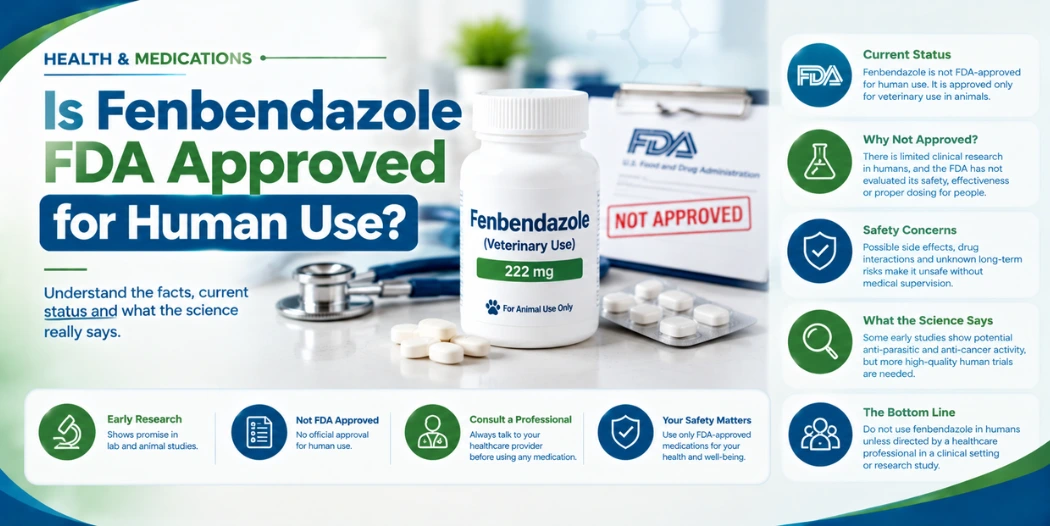
Fenbendazole is an antiparasitic medicine commonly used in veterinary care to treat different types of worm infections in animals. It belongs to the benzimidazole class of medicines and works by disrupting the ability of parasitic worms to absorb nutrients and produce energy.
Many people wonder whether Is Fenbendazole FDA Approved for Human Use. The answer is no. Fenbendazole is not FDA-approved for human use in the United States. Although it has established veterinary applications, its safety, effectiveness, and appropriate dosage for humans have not been established through sufficient clinical research.
Some people are interested in using Fenbendazole to treat human worm infections or cancer. These potential applications remain unproven and medical reports have identified serious risks including liver injury. Understanding Fenbendazole FDA approval, its veterinary uses, and available human treatment alternatives is important before considering any medicine for parasitic infections.
What Is Fenbendazole?
Fenbendazole is a broad-spectrum anthelmintic medicine primarily used to treat parasitic worm infections in animals. It belongs to a group of medications called benzimidazoles, which are commonly used to control certain intestinal parasites.
Veterinarians use Fenbendazole in dogs, cats, horses, cattle, and other animals, depending on the approved product and specific infection. It is effective against several types of worms, including roundworms, hookworms, whipworms, and certain tapeworms.
Fenbendazole works by interfering with the formation of microtubules, which are essential structures inside parasitic cells. This process affects the parasites’ ability to absorb nutrients and maintain normal cellular functions. As a result, the worms gradually lose energy and become unable to survive.
Is Fenbendazole FDA Approved for Human Use?
No. Fenbendazole is not approved by the U.S. Food and Drug Administration (FDA) for treating any human medical condition. People searching for is fenbendazole approved for human use fda should understand that the FDA has different approval processes for human and animal medicines.
Fenbendazole has received FDA approval for specific veterinary applications. However, these approvals apply only to the animal species, formulations, and treatment indications described in the relevant product labels.
The FDA evaluates human medicines based on scientific evidence demonstrating their safety and effectiveness for specific medical conditions. This evaluation generally includes clinical studies, manufacturing standards, and appropriate dosage information.
Currently, there is no FDA-approved Fenbendazole formulation intended for human consumption. Some veterinary product labels specifically warn that the medicine should not be used in humans.
Why Is Fenbendazole Not FDA Approved for Humans?
Fenbendazole has not received FDA approval for human treatment because sufficient evidence has not been established to support its safety and effectiveness in people.
Several important factors explain its current regulatory status.
1. Limited Human Research
Most Fenbendazole studies have been conducted on animals or in laboratories. There are not enough clinical studies involving humans to confirm its safety and effectiveness.
2. No Approved Human Dosage
There is no FDA-approved dosage of Fenbendazole for humans. The amount used to treat animals may not be safe or suitable for people.
3. Unknown Safety Risks
Researchers do not fully understand how Fenbendazole affects the human body. Some medical reports have linked its use to liver damage, and its long-term effects are still unclear.
4. Lack of Proven Effectiveness
Fenbendazole can treat certain worm infections in animals, but there is not enough reliable evidence to prove that it can safely and effectively treat parasites or cancer in humans. Fenbendazole has not received FDA approval for human use. Until proper human clinical studies confirm its safety and effectiveness, Fenbendazole should not be used as a human treatment.
What Is Fenbendazole FDA Approved to Treat?
Fenbendazole is an FDA-approved veterinary medicine used to treat certain parasitic worm infections in animals. It is commonly used in dogs, cattle, horses, goats, and other animals, depending on the approved product.
Fenbendazole helps treat different types of intestinal worms, including:
- Roundworms: Worms that live in the intestines and can affect digestion and nutrient absorption.
- Hookworms: Parasites that attach to the intestinal walls and feed on blood.
- Whipworms: Worms that live in the large intestine and can cause digestive problems.
- Certain Tapeworms: Intestinal parasites that can affect an animal’s digestive health.
Veterinarians recommend Fenbendazole based on the animal’s age, weight, health condition, and type of worm infection. Products such as Panacur and Safe-Guard contain Fenbendazole, but their approved uses vary by animal species and formulation. Although Fenbendazole for worms is effective for certain infections in animals, it is not FDA-approved for treating parasitic infections in humans.
Is Fenbendazole Safe for Human Consumption?
The safety of Fenbendazole in humans has not been adequately established. Although it is commonly used to treat parasites in animals, there is not enough research to confirm its safety for people.
Many people ask, can humans take fenbendazole? There is no FDA-approved dosage for humans, and taking it without medical advice may cause serious health problems, including liver damage.
People searching for fenbendazole safe for humans should understand that animal medicines are not always safe for people. Similarly, the question of fenbendazole is it safe for humans remains unanswered due to limited research. Always consult a healthcare professional before considering any treatment.
What Are the Possible Side Effects of Fenbendazole in Humans?
The complete side-effect profile of Fenbendazole in humans is not known because adequate clinical safety studies are lacking. However, some medical reports have identified serious health risks, especially liver damage.
Possible side effects and warning signs include:
- Liver injury: Fenbendazole has been associated with drug-induced liver injury, including severe cases.
- Nausea and abdominal discomfort: These symptoms have been described in some patients experiencing liver-related complications.
- Fatigue: Unusual tiredness may occur alongside liver dysfunction.
- Dark urine and jaundice: Dark-colored urine and yellowing of the skin or eyes can indicate significant liver problems.
- Abnormal liver enzyme levels: Medical reports have documented substantial increases in liver enzymes following Fenbendazole consumption.
Can Fenbendazole Be Used to Treat Parasites in Humans?
Fenbendazole is effective against several parasitic worms in animals but its effectiveness as a treatment for human parasitic infections has not been established through adequate clinical trials.
Human intestinal parasites such as roundworms, hookworms, and whipworms can cause digestive problems and other health issues. However, Fenbendazole for Humans is not FDA-approved because there is not enough evidence about its safety and effectiveness.
Doctors usually recommend approved medicines such as albendazole and mebendazole or ivermectin depending on the type of infection. Proper diagnosis and medical guidance are important for safe and effective treatment.
Is Fenbendazole FDA Approved for Cancer Treatment?
No. Fenbendazole is not FDA-approved for treating cancer in humans. Some laboratory and animal studies have explored whether Fenbendazole can affect cancer cells. However, these findings do not prove that it is safe or effective for cancer treatment in humans.
There is no reliable clinical evidence showing that Fenbendazole can cure cancer, shrink tumors or improve survival rates. Using Fenbendazole without medical guidance may cause serious health problems, including liver damage. People with cancer should consult their doctor before taking any unapproved medicine or alternative treatment.
Has Fenbendazole Been Studied in Humans?
Fenbendazole has been investigated extensively in veterinary medicine and in laboratory research. However, well-designed human clinical studies remain limited.
Most research on Fenbendazole falls into three main categories:
- Laboratory Research: Scientists have studied how Fenbendazole affects parasites and certain cells. However, laboratory results cannot prove that the medicine is safe or effective for humans.
- Animal Studies: Research shows that Fenbendazole can treat certain worm infections in animals. However, medicines can work differently in humans, so animal studies cannot confirm their safety for human use.
- Human Case Reports: Some medical reports describe people who have taken Fenbendazole without medical supervision. A few cases have reported serious liver problems, but these reports cannot determine how safe the medicine is for everyone.
The NIH’s LiverTox database updated in April 2026 identifies Fenbendazole as a probable cause of liver injury in humans. More human clinical studies are needed to understand its safety and effectiveness along with possible side effects and appropriate dosage. Until reliable evidence is available Fenbendazole should not be considered a proven or approved treatment for humans.
Fenbendazole vs Human Antiparasitic Medicines
Fenbendazole belongs to the same medicine family as certain antiparasitic drugs used in humans. Fenbendazole is not FDA-approved for human use, while albendazole, mebendazole, and ivermectin are approved for specific human infections.
These medicines have established human dosage guidelines and safety information for their approved uses. Understanding Mebendazole vs Fenbendazole is important because both belong to the benzimidazole group but have different approved applications.
Fenbendazole is mainly used in veterinary medicine while Mebendazole treats certain intestinal worm infections in humans. Patients should always consult a healthcare professional before choosing any antiparasitic medicine.
What Happens if a Human Takes Fenbendazole?
The effects of Fenbendazole consumption in humans are difficult to predict because its human safety profile has not been adequately established. Some people may experience no immediate symptoms, while others may develop side effects such as nausea, stomach pain, tiredness, or liver problems. The risks may depend on the amount taken and the person’s health condition.
Anyone who takes Fenbendazole should avoid further doses and contact a healthcare professional. Serious symptoms, including yellowing of the skin or dark urine, require urgent medical attention.
Conclusion
Fenbendazole is an established veterinary antiparasitic medicine used to treat several types of worm infections in animals. However, its long history in veterinary care should not be confused with approval for human medical treatment.
The central answer to the question Is Fenbendazole FDA Approved for Human Use? is no. The U.S. Food and Drug Administration has not approved Fenbendazole for treating parasitic infections or cancer or any other human medical condition.
Although laboratory research has explored its biological properties, there is insufficient clinical evidence to establish its safety and effectiveness in humans. More importantly published medical reports have identified serious health concerns including drug-induced liver injury.