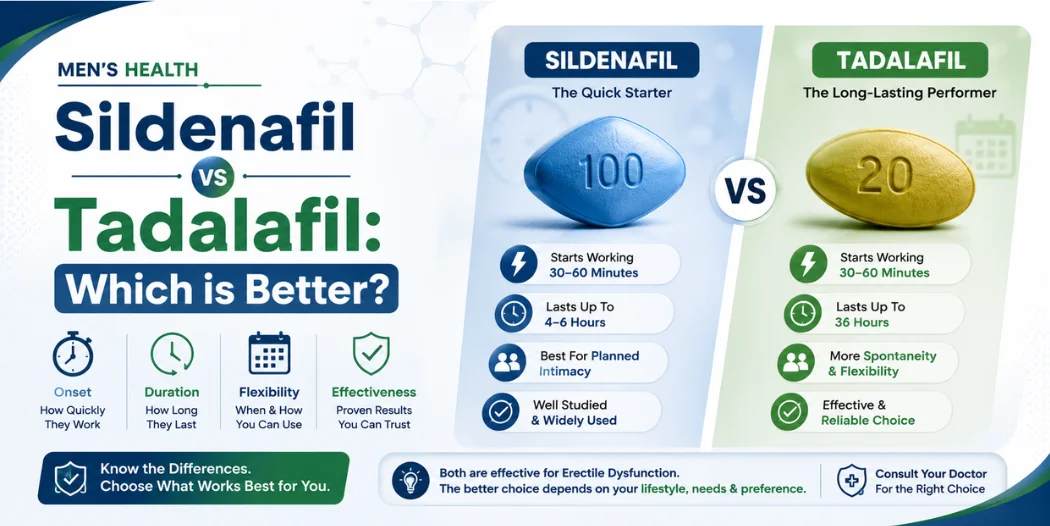
Erectile dysfunction (ED) can make it difficult to get or keep an erection during sexual activity. Sildenafil and tadalafil are two commonly used medicines for treating ED. Both belong to a group of medicines called PDE5 inhibitors. They work by increasing blood flow to the penis when a person is sexually stimulated.
Although both medicines are used for the same condition, they are not exactly the same. They differ in how quickly they start working, how long their effects last, how they are taken, and how food and other medicines may affect them. This is why people often compare tadalafil vs sildenafil when looking for an ED treatment.
Sildenafil is usually taken when needed before sexual activity, while tadalafil can provide a longer period of effectiveness and may also be prescribed as a daily treatment for some people. The choice is not simply about which medicine is stronger. Factors such as health condition, other medicines, treatment needs, and individual response also matter.
In this guide, we will compare Sildenafil vs Tadalafil: Which is better?. We will look at how they work, how quickly they take effect, how long they last, their common side effects, dosage considerations, and important safety precautions. A healthcare professional can help determine which option is suitable for your individual needs.
What Are Sildenafil and Tadalafil?
Sildenafil and Tadalafil are prescription medicines belonging to the PDE5 inhibitor class. They are used to help men with erectile dysfunction achieve and maintain an erection suitable for sexual activity.
What Is Sildenafil?
Sildenafil works by inhibiting the PDE5 enzyme. This helps maintain higher levels of cyclic guanosine monophosphate (cGMP), which relaxes the muscles in the penis and improves blood flow during sexual stimulation.
Sildenafil is commonly used as needed before sexual activity. It helps men with erectile dysfunction get and maintain an erection when they are sexually aroused. The medicine does not increase sexual desire or cause an erection by itself. Sexual stimulation is still needed for sildenafil to work effectively.
What Is Tadalafil?
Tadalafil is another PDE5 inhibitor used to treat erectile dysfunction. It works in a similar way to sildenafil by helping increase blood flow to the penis during sexual stimulation. One of its main differences is that tadalafil has a longer-lasting effect. It can be taken when needed or once daily for certain patients, depending on the treatment prescribed by a healthcare professional.
Tadalafil is also approved for treating symptoms of benign prostatic hyperplasia (BPH) in appropriate patients. When looking at the difference between sildenafil and tadalafil, both medicines work in a similar way, but they differ in how long they work, how they are taken, and how they may fit into an individual’s treatment needs.
How Do Sildenafil and Tadalafil Work?
Sexual stimulation causes the release of nitric oxide in penile tissue. This contributes to the production of cGMP, which helps relax smooth muscle and allows blood to flow into the penis.
Normally, PDE5 breaks down cGMP. Sildenafil and tadalafil inhibit PDE5, allowing cGMP to remain active for longer. This supports increased blood flow and helps facilitate an erection when sexual stimulation occurs.
Neither medicine works as an automatic erection-producing drug. Sexual stimulation is still required. If you want a broader explanation of this drug class, PDE5 Inhibitors Explained can provide additional background on how these medicines work.
Sildenafil vs Tadalafil: Key Differences
Sildenafil and tadalafil are both used to treat erectile dysfunction (ED), but they differ in how long they work, how they are taken, and how food may affect them.
| Feature | Sildenafil | Tadalafil |
| Medicine type | PDE5 inhibitor | PDE5 inhibitor |
| How it is taken | Usually as needed | As needed or once daily, when prescribed |
| How long it works | Shorter duration | Longer duration |
| Effect of food | A high-fat meal may slow its effect | Food does not significantly affect absorption |
| Sexual stimulation | Needed for an erection | Needed for an erection |
| Common side effects | Headache, flushing, indigestion, stuffy nose, and vision changes | Headache, indigestion, back pain, muscle aches, and stuffy nose |
| Other uses | Depends on the specific formulation | Also used for symptoms of an enlarged prostate (BPH) |
| Treatment window | More focused around the time it is taken | Provides a longer window of opportunity |
Both medicines can be effective for ED, but people can respond differently to each one. Tadalafil has a longer duration of action and, in approved as-needed use, may support erectile function for up to 36 hours after a dose. This does not mean an erection lasts for 36 hours; sexual stimulation is still required.
Sildenafil vs Tadalafil: Which Works Faster?
Both sildenafil and tadalafil are used to treat erectile dysfunction (ED). They need some time to start working, and the exact response can vary from person to person.
Sildenafil
Sildenafil is usually taken about one hour before sexual activity. It may begin working within around 30 minutes, although the timing can vary between individuals. It helps improve blood flow to the penis when sexual stimulation is present. Taking sildenafil with a heavy or high-fat meal may slow its absorption and delay its effects. For this reason, following the prescribed instructions about timing and meals can help the medicine work as expected. Individual responses may vary depending on health and other factors.
Tadalafil
Tadalafil needs some time to start working, but it remains active in the body for much longer than sildenafil. This provides a wider window for sexual activity, so users may have more flexibility with timing. Tadalafil can be taken with or without food, and its longer duration means sexual activity does not always need to be planned around a short time period. Individual results can vary based on health, medicines, and other factors.
Sildenafil vs Tadalafil: Which Lasts Longer?
One of the main differences between sildenafil and tadalafil is how long their effects can last. Sildenafil has a comparatively shorter period of action and is generally used when sexual activity is anticipated. This makes timing an important part of treatment.
Tadalafil has a much longer treatment window than sildenafil. When used as prescribed, it can improve erectile function for up to 36 hours after a dose. This does not mean an erection lasts for 36 hours; sexual stimulation is still needed. This longer window is one reason people frequently search for sildenafil vs tadalafil when deciding which treatment may fit their lifestyle.
Sildenafil vs Tadalafil for Erectile Dysfunction
Both medicines can be effective treatments for erectile dysfunction. However, effectiveness should not be judged simply by how long a medicine remains in the body.
ED can have many causes, including vascular conditions, diabetes, certain medications, hormonal issues, psychological factors, and other health conditions. Treatment response can therefore differ considerably between individuals.
Sildenafil is generally taken when needed before sexual activity, while tadalafil can be taken as needed or once daily when prescribed. Tadalafil also provides a longer window of effectiveness, which may offer more flexibility for some people.
A healthcare professional can consider your health history, current medicines, and treatment needs before deciding which option may be suitable. For more information about sildenafil, read our Sildenafil guide to learn about its uses, how it is taken, and important safety considerations.
Sildenafil vs Tadalafil: Side Effects
Both sildenafil and tadalafil can cause side effects because they affect blood vessels and blood flow.
Common Side Effects of Sildenafil
Some people taking sildenafil may experience:
- Headache
- Facial flushing or warmth
- Indigestion
- Stuffy or blocked nose
- Dizziness
- Changes in vision
Common Side Effects of Tadalafil
Tadalafil may cause:
- Headache
- Indigestion
- Back pain
- Muscle pain
- Stuffy or blocked nose
- Facial flushing
Back and muscle pain are among the side effects associated with tadalafil, while visual changes can occur with sildenafil. Serious symptoms require medical attention. An erection lasting more than four hours is an emergency because untreated priapism can cause permanent damage. Sudden vision or hearing changes also require prompt medical evaluation.
Sildenafil vs Tadalafil: Dosage and How to Take Them
Dosage should always follow the prescription and advice provided by a healthcare professional. The appropriate dose can vary depending on age, other medicines, kidney or liver function, and overall health.
Sildenafil is generally used on an as-needed basis for ED. The timing of the dose in relation to sexual activity and the effect of food should be considered according to the prescribing information.
Tadalafil offers more than one dosing approach for ED. Approved labeling includes an as-needed option as well as a once-daily option. For as-needed treatment, the labeled starting dose is 10 mg, with adjustment based on effectiveness and tolerability. Once-daily ED treatment may start at 2.5 mg and can be increased to 5 mg when appropriate. Tadalafil can be taken without regard to food.
Do not take more than the recommended dose or combine sildenafil and tadalafil unless your doctor specifically tells you to do so. Your doctor can help choose the right option and dose based on your health and treatment needs. For more information, read our Tadalafil guide to learn about its uses, dosing, and safety precautions
Sildenafil vs Tadalafil: Which One May Be Suitable?
There is no single choice that is appropriate for every person. The better fit depends on what the patient needs from treatment and whether the medicine is medically appropriate.
Sildenafil may be considered for people who:
- Prefer an as-needed treatment
- Usually plan sexual activity in advance
- Do not require a prolonged treatment window
- Have been assessed as suitable for sildenafil
Tadalafil may be considered for people who:
- Prefer a longer treatment window
- Want more flexibility around the timing of sexual activity
- May be suitable for once-daily treatment
- Have ED and, where appropriate, symptoms of BPH
Both medicines can help with erectile dysfunction, but they work differently in terms of timing and duration. A longer-lasting effect does not automatically mean tadalafil is better, and a shorter duration does not mean sildenafil is less effective. The most suitable option depends on your individual needs and medical condition.
Can Sildenafil and Tadalafil Be Taken Together?
Sildenafil and tadalafil should generally not be taken together unless a doctor specifically tells you to do so. Both medicines work in a similar way by blocking the PDE5 enzyme. Taking them together may increase the risk of side effects such as low blood pressure, dizziness, fainting, changes in vision, and a prolonged erection.
If one medicine is not working well enough, do not add the other on your own. Talk to a healthcare professional about whether changing the medicine or adjusting the treatment would be more suitable. Always tell your doctor about any prescription medicines, over-the-counter medicines, or supplements you are taking. This can help prevent potentially harmful drug interactions.
Sildenafil vs Tadalafil: Which Is Better for You?
There is no single medicine that is best for everyone. The right choice depends on your health, treatment needs, and how your body responds to the medicine. When comparing sildenafil or tadalafil, think about how you want the treatment to work. Sildenafil is usually taken when needed and has a shorter duration. Tadalafil lasts longer and can also be prescribed as a daily treatment for some people.
Your health and other medicines are also important. People who take nitrate medicines should not use sildenafil or tadalafil because the combination can cause a dangerous drop in blood pressure. Other factors, such as heart problems, blood-pressure medicines, kidney or liver conditions, and other medications, can also affect which medicine is suitable.
So, when asking “Sildenafil vs Tadalafil: Which is better?”, the answer depends on the individual. A healthcare professional can help choose the option that is appropriate for your health and treatment needs.
Conclusion
Sildenafil and tadalafil are both PDE5 inhibitors used to treat erectile dysfunction (ED), but they work differently in terms of timing and duration. Sildenafil is usually taken when needed and has a shorter effect, while tadalafil lasts longer and may also be prescribed as a daily treatment for suitable patients.
Choosing between sildenafil and tadalafil depends on factors such as how quickly you need the medicine to work, how long you want its effects to last, food considerations, possible side effects, other medicines, and your overall health. Neither medicine is automatically better for everyone.
Sildenafil and tadalafil should not be taken together unless a healthcare professional advises it. Both can interact with other medicines, especially nitrates, which can cause a dangerous drop in blood pressure. Persistent ED should also be evaluated by a healthcare professional.