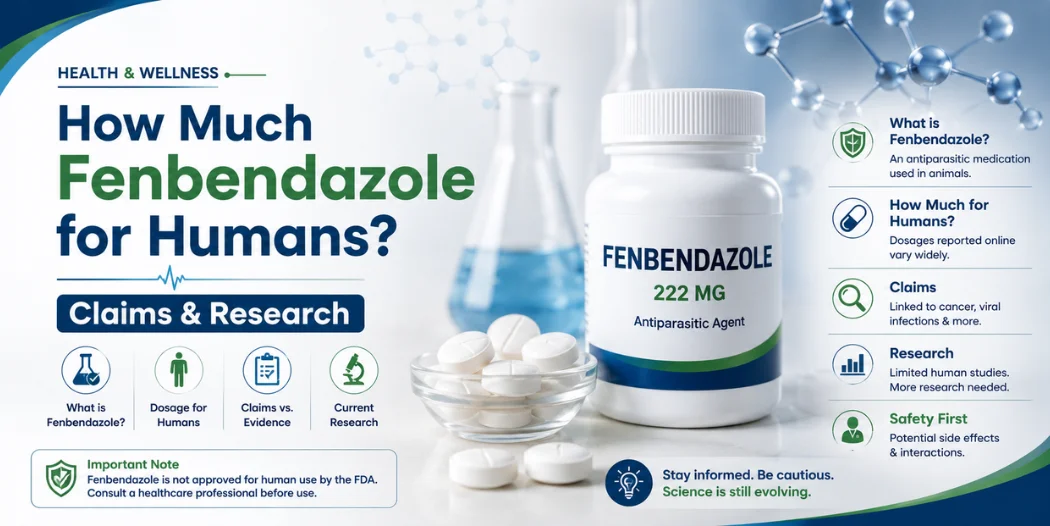
Fenbendazole is a benzimidazole antiparasitic medicine primarily developed and used in veterinary medicine. Interest in fenbendazole for humans has increased because of online discussions about its possible use against parasites and cancer. However, its use in animals should not be confused with an established medical indication for humans.
Current literature does not establish a standard human dosage or confirm fenbendazole as an approved treatment for cancer. A 2024 review also noted that human pharmacokinetic and safety data remain insufficient and that clinical trials are needed to determine appropriate doses, treatment schedules, and tolerability.
This article reviews How Much Fenbendazole for Humans? why people search for human dosage information, what research has found so far, and where important evidence gaps remain. It is important to distinguish laboratory findings and personal reports from results demonstrated in well-designed human clinical studies.
What Is Fenbendazole?
Fenbendazole is a benzimidazole-class anthelmintic used to control certain parasitic worms in animals. It is used in veterinary medicine for species such as dogs and other animals, depending on the specific product and approved indication. FDA records list approved fenbendazole products for veterinary use.
The drug works against susceptible parasites by interfering with cellular processes that are important for their survival. Because compounds in the benzimidazole class can affect parasite microtubules, researchers have also investigated whether fenbendazole may influence similar pathways in cancer cells.
This research has created considerable interest, but laboratory activity does not automatically mean that a medicine is effective or safe for people. Human medicines require appropriate evidence covering effectiveness, dosing, quality, and safety before they can be approved for a particular use.
Is Fenbendazole Approved for Human Use?
No. Fenbendazole is not approved by the U.S. FDA for use in humans. It is mainly used as a veterinary medicine to treat certain parasitic infections in animals. It is important to understand that a medicine approved for animals is not automatically safe or approved for people. Human medicines must go through clinical studies to evaluate their safety, proper dosage, and effectiveness before they can be approved for specific uses.
A 2024 review also reported that fenbendazole was not approved by the FDA or EMA for human use and that there is limited information about how the medicine works in the human body and its safety in people. For this reason, claims about fenbendazole for human use should be considered carefully, especially when they are based on animal studies, laboratory research, or personal experiences rather than well-designed human clinical studies.
Is There a Standard Fenbendazole Dosage for Humans?
There is no standard human dose of fenbendazole that is officially recommended for treatment. People searching for how much fenbendazole for humans may find different dosage schedules online. These may be based on personal experiences, veterinary use or experimental research. They are not the same as an approved human dosing guideline.
A dose used for animals should not simply be changed based on a person’s body weight. The right dose of a medicine can depend on factors such as the health condition, other medicines, liver function, and how the medicine is absorbed by the body.
For this reason online fenbendazole dosage charts should not be considered reliable medical advice. More human research is needed to determine whether fenbendazole can be used safely in people and what dose if any would be appropriate.
Fenbendazole Dosage for Humans: What Research Shows
Most research on fenbendazole has focused on its use in animals and on early laboratory studies. Research in humans is still limited. A 2024 review found that more human studies are needed to understand how fenbendazole may work in people. Researchers also need more information about the right dose, treatment duration, and possible side effects.
At present there is no standard fenbendazole dosage for humans that can be recommended as a general treatment. Some veterinary products are available in strengths such as Fenbendazole 500 mg. However the strength shown on an animal medicine does not mean it is a safe or suitable dose for humans.
The formulation of veterinary medicines may also be different from medicines made for people. They can have different ingredients, labeling, quality standards, and approved uses Based on current research human use of fenbendazole is still being studied. More clinical research is needed before a safe and effective human dose can be established.
Fenbendazole for Cancer: Why Are People Talking About It?
Interest in fenbendazole for cancer has grown because of laboratory research, early studies, and stories shared online. Some people are interested in whether fenbendazole may have an effect on cancer cells. Researchers have studied how fenbendazole may affect cancer cells and certain processes involved in cell growth. Some laboratory studies have shown that it can affect microtubules and other cellular processes. Studies in animals have also reported anticancer effects in certain cancer models.
However, these results do not prove that fenbendazole can treat cancer in humans. A medicine may show an effect in laboratory or animal studies but may not provide the same results in people. More human research is needed to understand whether fenbendazole is safe and effective for cancer treatment. This is why online claims about fenbendazole should be considered carefully and should not be taken as proof that it can cure or treat cancer.
Fenbendazole Cancer Claims vs Scientific Evidence
Some people online talk about fenbendazole as a possible cancer treatment or even a cure. However, current research does not provide enough evidence to consider fenbendazole an established cancer treatment.
| Claim | What Research Shows |
| Fenbendazole can kill cancer cells | Some laboratory studies have shown that fenbendazole may affect cancer cells. |
| Fenbendazole can shrink tumors | Some animal studies have shown effects on tumors. However, this does not prove that it works in people. |
| Fenbendazole cures cancer | There is not enough human evidence to show that fenbendazole can cure cancer. |
| Fenbendazole can replace cancer treatment | Current evidence does not support using fenbendazole instead of approved cancer treatments. |
| Fenbendazole is safe for long-term use in cancer patients | Human safety information is limited. Some reports have linked self-use of fenbendazole with serious liver injury. |
It is important to understand the different levels of research. Laboratory studies can show how a drug may affect cancer cells. Animal studies can provide more information about how it may work in a living body. However, human clinical studies are needed to know whether a treatment is truly safe and effective for people.
What Human Studies Have Found
Research on fenbendazole in humans is still limited compared with medicines that are approved for human use. A 2025 publication reported three people who used fenbendazole along with other treatments for advanced cancer. However, the evidence was limited and the publication was later marked as retracted in PubMed. Because of this, it should not be considered reliable proof that fenbendazole can treat cancer. Some published reports have also raised safety concerns.
One case involved an older person with lung cancer who developed serious liver problems after using fenbendazole based on information found on social media. The liver problems improved after fenbendazole was stopped. Another report also described serious liver injury linked to the use of veterinary fenbendazole. These cases do not show how often side effects may happen. However, they show why online claims about fenbendazole safety should be viewed carefully.
Is Fenbendazole Safe for Humans?
The question is fenbendazole safe for humans cannot currently be answered with the same level of certainty available for approved human medicines. The main issue is limited human safety data. A drug may appear well tolerated in animals or in a small number of people while still presenting risks that become apparent only through broader clinical use.
Published case reports have raised particular concern about liver injury. One 2024 report described severe drug-induced liver injury after self-administration of fenbendazole, while another report described liver injury following its use based on social-media information.
Safety may also become more complicated when people combine unapproved medicines with cancer treatments or other drugs. A recent case report described severe liver injury following combined self-administration of veterinary fenbendazole and ivermectin in a patient with prostate cancer. These findings highlight why the absence of large human safety studies should not be interpreted as proof that the drug is harmless.
Fenbendazole Side Effects in Humans
There is not enough human research to clearly explain how often fenbendazole may cause specific side effects. However, some published reports have raised concerns about liver problems in people who used fenbendazole.
In some cases, people who self-administered fenbendazole developed serious liver injury. Reports have also described liver damage in people who used the veterinary medicine after seeing cancer-related claims online. Fenbendazole may also cause changes in liver enzyme levels. These changes can sometimes be temporary but may also become more serious in certain cases.
Because safety information in humans is limited, people should not assume that fenbendazole is safe simply because others have used it without noticeable problems. More research is needed to understand its safety in humans.
Can Fenbendazole Be Used for Parasites in Humans?
Fenbendazole is an antiparasitic medicine mainly used in veterinary medicine to treat certain worm infections in animals. It is not an approved deworming medicine for people. Some human antiparasitic medicines such as albendazole and mebendazole are approved for specific parasitic infections and have established dosing and safety information.
The right treatment depends on the type of parasite and the person’s health condition. Using fenbendazole without proper medical guidance may not treat the actual infection and could delay the correct treatment. Symptoms such as stomach pain, diarrhea, weight loss or tiredness can also have many different causes. For this reason fenbendazole should not be considered a standard treatment for parasitic infections in humans.
Can Humans Take Fenbendazole?
The fact that people can physically ingest a veterinary medicine does not mean that it has been established as safe or effective for human treatment. Current evidence does not establish a general human indication or standard dosage for fenbendazole. Therefore, can humans take fenbendazole is not simply a question of whether the medicine can be swallowed. It is a question of whether its benefits, risks, formulation, dose, and intended use have been adequately evaluated in humans.
This is particularly important for people considering fenbendazole because of cancer-related claims. Experimental use should not replace proven cancer treatments or delay appropriate medical evaluation. People considering an investigational medicine should discuss the situation with an appropriate healthcare professional, particularly if they are already taking prescription medicines or receiving cancer treatment.
Fenbendazole vs Approved Human Antiparasitic Medicines
Fenbendazole is mainly used as a veterinary antiparasitic medicine. It is different from medicines that have been developed and tested specifically for treating parasites in humans.
| Factor | Fenbendazole | Approved Human Antiparasitic Medicines |
| Main use | Veterinary medicine | Human medical treatment |
| Human approval | Not approved for human use | Approved for specific conditions |
| Human dosage | No standard dose established | Doses are established for approved uses |
| Safety information | Limited human data | Supported by human studies |
| Intended use | Treats certain parasites in animals | Treats specific parasitic infections in humans |
| Clinical evidence | Limited human evidence | More established for approved uses |
Conclusion
Fenbendazole has gained attention because it is used to treat parasites in animals and has also been studied for its possible effects on cancer cells. However, current research does not show that fenbendazole is an approved or proven treatment for people.
There is no standard fenbendazole dosage for humans that can be recommended for general use. Most research on its possible cancer benefits is still based on laboratory and animal studies. Human evidence remains limited. Some reports have also linked self-use of fenbendazole with serious liver problems.
It is important to separate scientific research from claims shared online. Early research can be useful for future studies but does not prove that a medicine is safe or effective for humans.